
Criminal Cases in the Fisher County Courts
Fisher County criminal cases are divided by jurisdiction. The 32nd Judicial District Court has original jurisdiction over felonies and also serves Mitchell and Nolan Counties. The constitutional County Court handles Class A and B misdemeanors, while a regional multicounty court may receive an assignment. Justice courts and Rotan Municipal Court keep fine-only matters within their own jurisdiction. The court named on the cause, not the arrest charge alone, tells a requester which clerk owns the file.
For a lower-court Fisher County case, call Justice of the Peace Precinct 1 at 325-776-2482 and verify the counter location before travel. Rotan Municipal Court is at 302 W. Sammy Baugh Avenue, Rotan, TX 79546, phone 325-735-2251. Give the citation, cause number, name, and filing period when known. Those courts are separate record custodians, so a District Clerk search does not replace either channel.
The official Texas trial-court jurisdiction summary shows why charge level matters in Fisher County. It separates district felony jurisdiction from county misdemeanor and lower-court work.

That structure is the first filter in a Fisher County case search because no one clerk holds every criminal docket.
Fisher County Felony Cases
District Clerk Gina Pasley is the custodian for Fisher County felony case files. The office is at 112 N. Concho Street in Roby, with mail sent to P.O. Box 88, Roby, TX 79543. Call 325-776-2279 or fax 325-776-3253. The county page also provides forms, fee information, e-filing material, a public-information form, and a petition for an order of nondisclosure. It does not expose a public Fisher felony search screen.
The official Fisher County District Clerk page is the source for the current office channel.
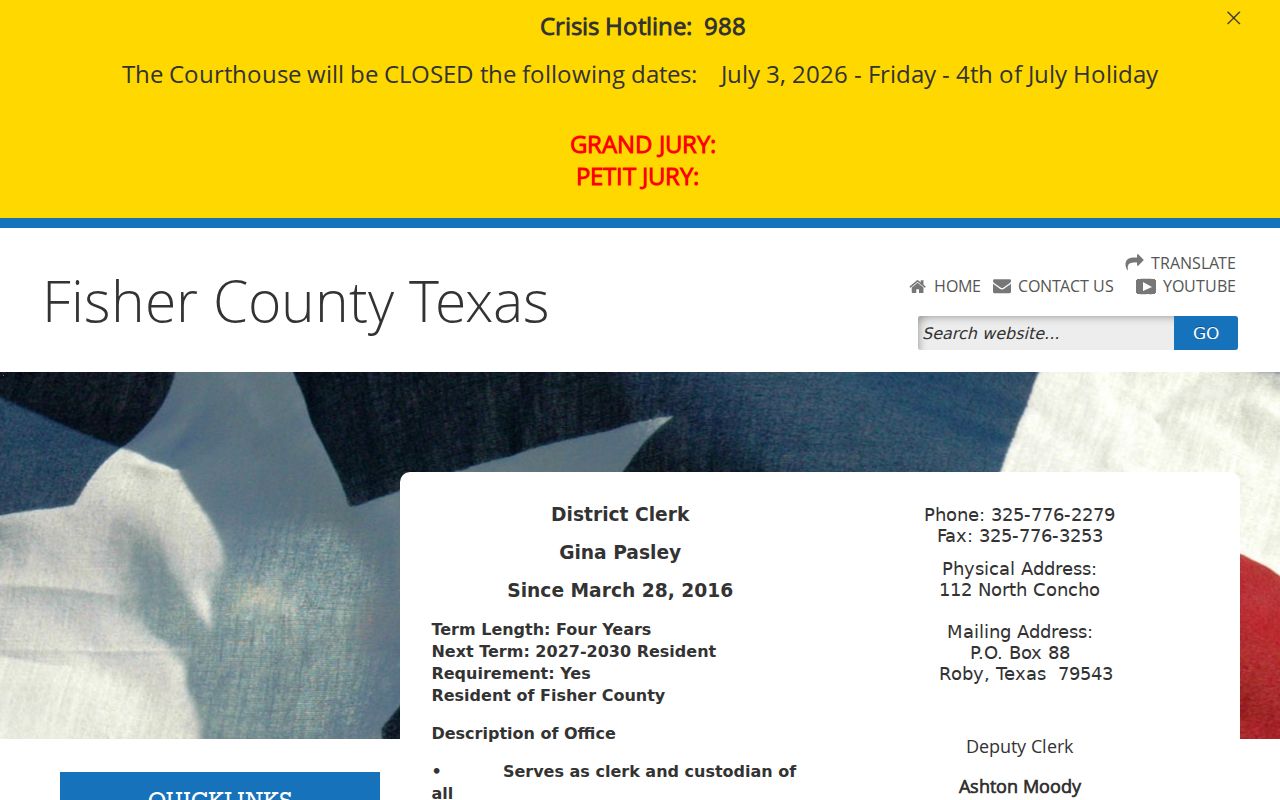
For a useful search, give the defendant name, an approximate filing year, a cause number if known, and a date of birth if the clerk accepts it as a match aid. Ask first for the docket or index, then identify the exact pleadings, orders, or certified disposition needed.
How to Search Case Records
Fisher County offers different routes for felony and misdemeanor case records. A name alone can collide with another person, so add a year, cause number, or other accepted identifier. The steps below keep a misdemeanor web result from being mistaken for a felony search.
- Identify the likely charge level. Contact the District Clerk for a felony, the County Clerk for a Class A or B misdemeanor, or the issuing lower court for a fine-only matter.
- For a misdemeanor, open the County Clerk-authorized LGS Online Records Search, use Guest Login, select Search, choose the office and Criminal record type, then enter the available record-dependent criteria.
- For a felony, call or write the District Clerk with the defendant name, filing year or date, cause number, and any accepted match detail. There is no public felony portal to open.
- Review the docket or index before ordering. Note the court, charge, status, judgment date, and document names that answer the question.
- Request plain or certified copies from the correct clerk. Confirm the current charge, delivery method, scan status, and whether an older file must be pulled for inspection.
The verified LGS controls and workflow are limited to what Fisher County and its official portal documentation publish. The live private criminal criteria were not opened.
| Field or Control | Type | Required | Use |
|---|---|---|---|
| Email Address | Text | Registered login only | Signs in a registered user |
| Password | Password | Registered login only | Completes registered access |
| Guest Login | Button | No | Opens free index and preview access |
| Office and record type | Selection | Yes in search flow | Choose the clerk office and Criminal |
| Record criteria | Record dependent | Varies | Official example uses Last Name; no other criminal fields are assumed |
Why re:SearchTX Misses Fisher County Cases
Texas has no comprehensive public statewide search for Fisher County criminal trial cases. re:SearchTX is a broad document-access system, but the Texas Judicial Council reports that criminal case records are excluded. A no-result there does not establish that Fisher County has no file. It means the search must return to the district, county, justice, or municipal clerk that holds the cause.
This local-clerk rule also applies when a cause moved between prosecution stages. DPS may hold a reportable conviction or deferred-adjudication event, but its public name product is not the court docket. The Fisher clerk file can show an indictment, settings, motions, plea papers, judgment, sentence, costs, revocation activity, and an appellate mandate that the public DPS result does not display.
Note: A statewide name result cannot replace the Fisher County judgment when the exact disposition, sentence, or filing history matters.
What the Case File Shows
A Fisher County case file records what the prosecutor filed and what the court did with it. The booking allegation may differ from the information or indictment, and either can differ from the final judgment. Match the cause number, court, dates, statute, and disposition before treating two entries as the same prosecution.
| Case Number & Court | Identifies the cause and the Fisher County court with custody of the file. |
|---|---|
| Charging Document | The complaint, information, or indictment states the charge accepted for court action. |
| Docket Entries | Lists filings, settings, appearances, motions, orders, pleas, and post-judgment events. |
| Hearing Dates | Shows scheduled and completed settings, though a docket listing alone is not the full file. |
| Disposition & Judgment | Records dismissal, plea, trial result, adjudication, and the signed judgment when available. |
| Sentence & Conditions | May state confinement, fine, costs, community supervision, and later revocation or modification. |
Sensitive data can be redacted. Date of birth, victim identifiers, addresses, and protected exhibits may not appear in a public copy even when the basic case remains open to inspection.
Fisher County Dockets Versus Case Files
The Fisher County docket page can help locate scheduled county matters, but it is not a complete historical case index.
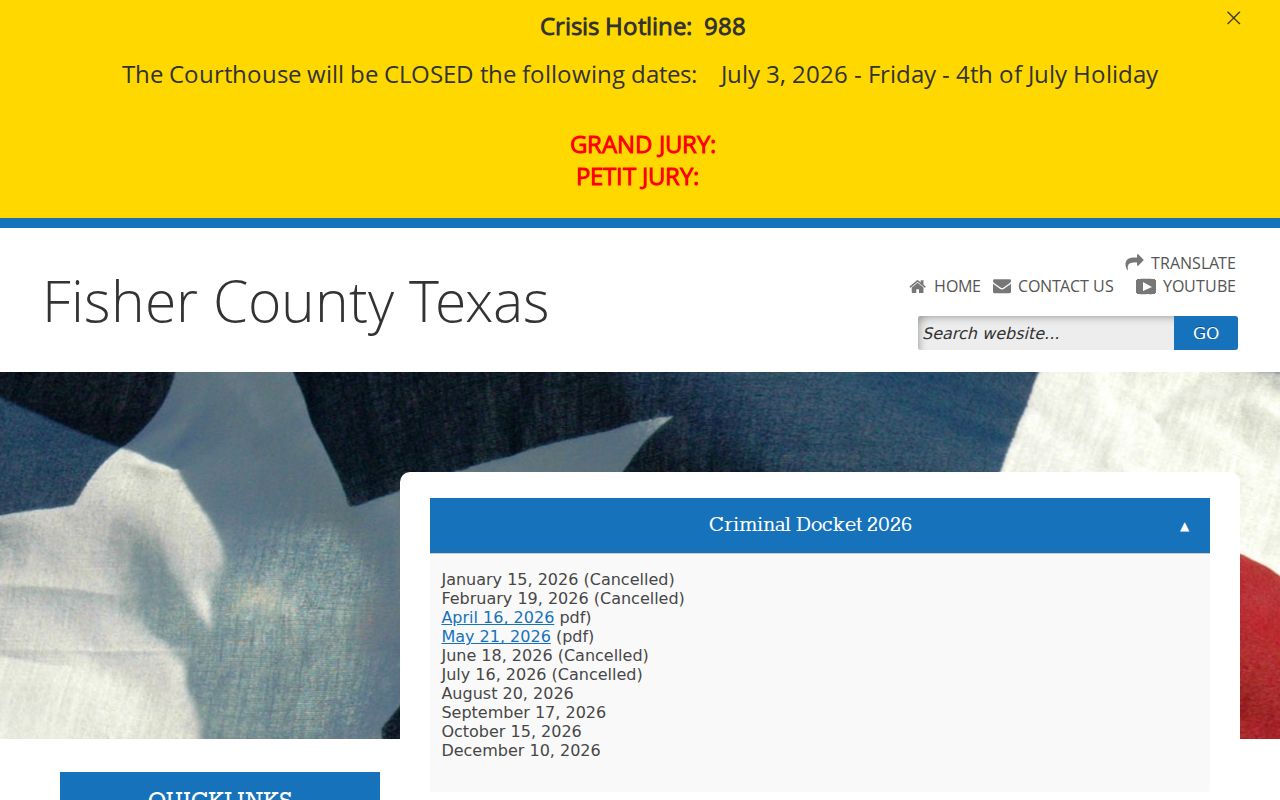
A docket notice answers when a matter is set. The case file answers what was filed, what orders were entered, and how the charge ended. If the listing supplies a cause number, use it in a clerk request. Ask for the charging instrument, docket sheet, plea papers, judgment, sentence or community-supervision order, dismissal, and any revocation or appeal record that bears on the outcome.
The County Clerk holds Class A and B misdemeanor material. Its official Fisher County page links the LGS search and lists the office at 109 N. Angelo, with mail routed to P.O. Box 368, Roby, TX 79543. Phone 325-776-2401 before visiting or mailing a request.
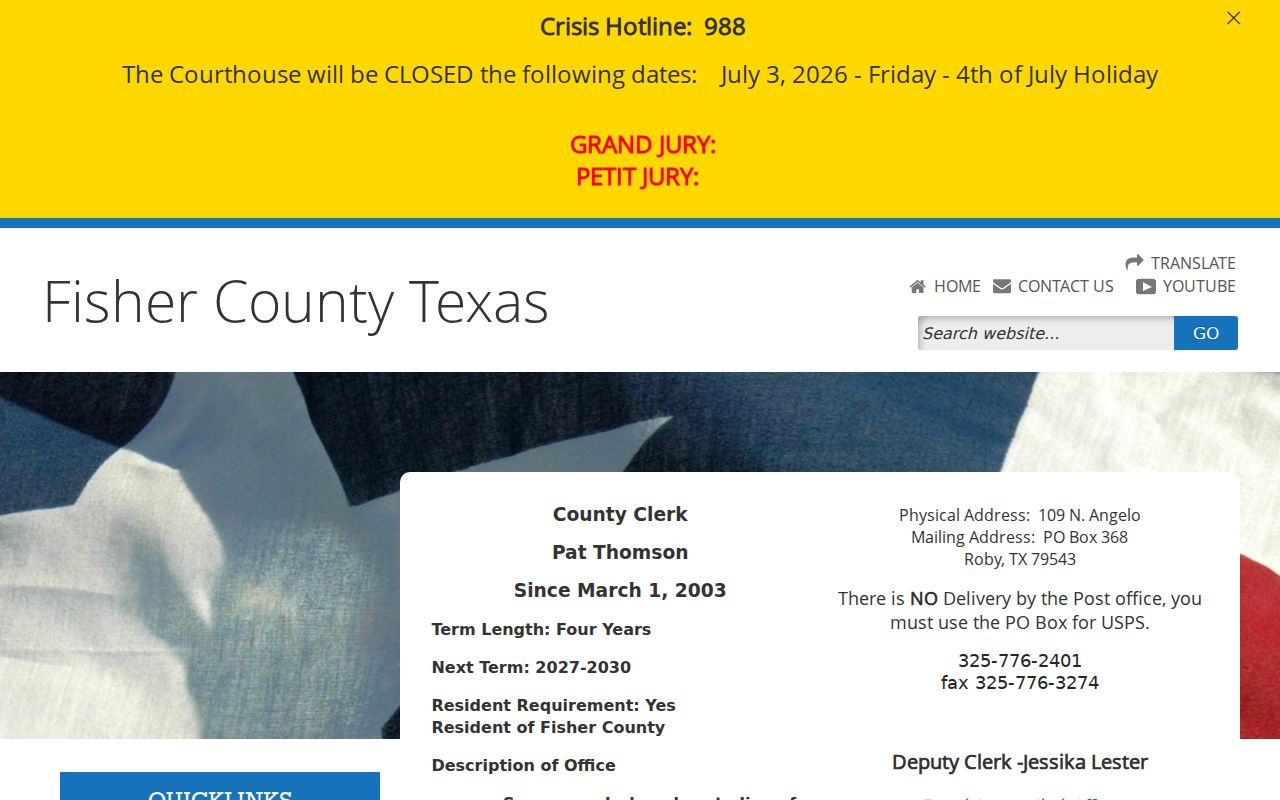
The image confirms the county-level channel that complements, rather than replaces, the District Clerk felony route.
Stages of a Criminal Case
A Fisher County criminal cause begins in court when a charge is filed, not merely when an arrest occurs. Counsel may appear or be appointed, an indictment may be returned in a felony, and the court can set arraignment, bond, pretrial hearings, and motion dates. A plea or trial may lead to dismissal, acquittal, or judgment. Sentencing and community-supervision terms can follow, with later motions to revoke, capias entries, appeal, or mandate.
Case flow: Charges Filed › Arraignment › Pretrial › Plea or Trial › Disposition › Sentencing
The 32nd District Court page is the county source for the felony court.
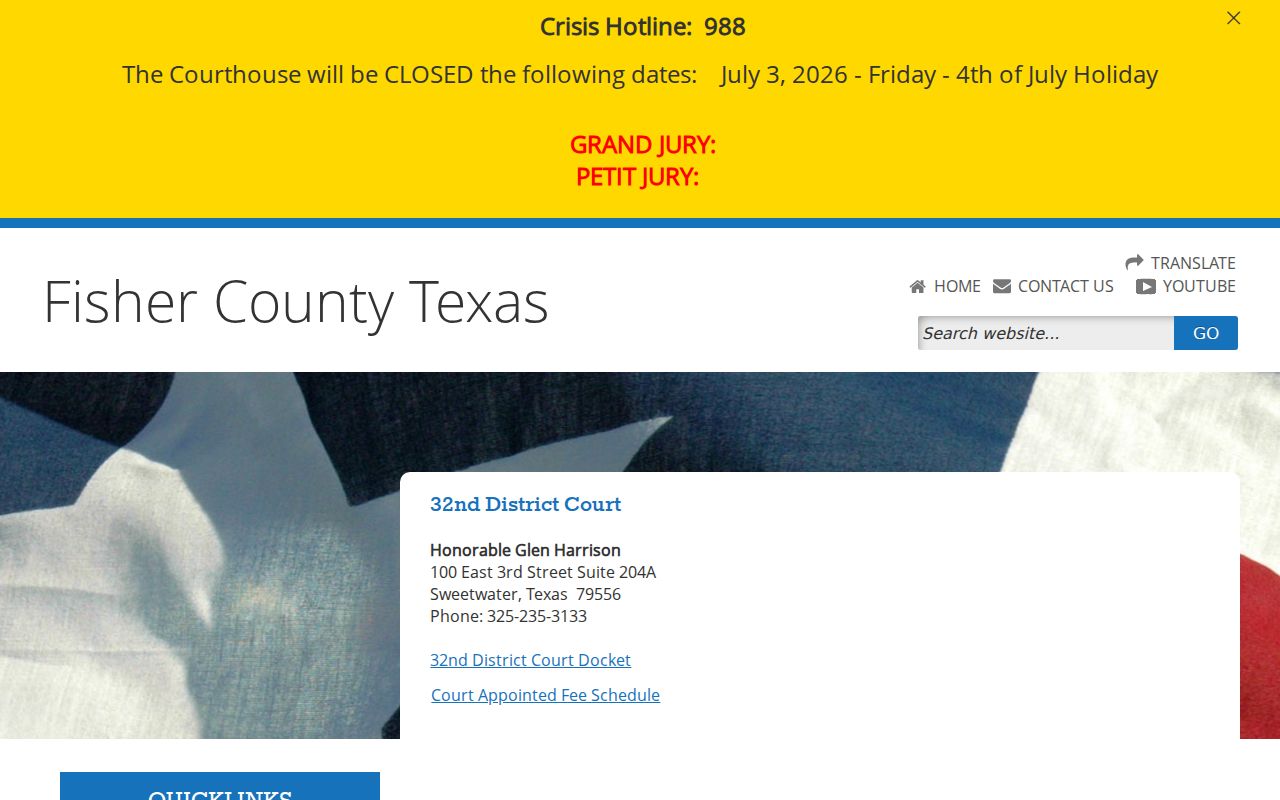
That multicounty setting is why the clerk and cause number are more reliable search keys than a guess based only on where an arrest occurred.
Reading Fisher County Case Docket Events
Docket terms mark procedural acts, not always a final result. “Case filed” starts the court record. “Indictment returned” means a grand jury issued the charging instrument; it is not a conviction. A “capias” is an order directing custody or appearance, while “recalled” indicates later court action that should be verified in the signed order. A motion to revoke or adjudicate asks the court to act on supervision; the motion alone does not prove revocation.
- Arraignment
- The hearing at which the accusation is addressed and a plea may be entered.
- Disposition
- The recorded outcome of a charge, such as dismissal, conviction, or acquittal.
- Judgment
- The signed court record of the result and sentence.
- Capias
- A court command to take a person into custody or bring that person before the court.
When a short index label is unclear, request the underlying order. A certified disposition is especially useful when correcting a mismatch in the Texas Department of Public Safety Computerized Criminal History system.
Access & Restrictions
Judicial records do not follow the Texas Public Information Act in the same way as sheriff records. The Texas judiciary open-records policy explains that courts are not governmental bodies under that act. Access instead rests on court rules, statutes, common-law openness, and the clerk's custodial role. Send a case-copy request to the clerk, not a sheriff-style public-information demand.
Fisher County public case access can still exclude or redact juvenile material, protected victim data, sensitive identifiers, sealed files, expunged records, and information covered by an order of nondisclosure. An online preview may also omit a record that exists on paper. Ask the clerk whether the cause is restricted, indexed under another spelling, archived, or awaiting scan. If access is denied, request the legal basis and the correct court review route.
Finding Paper Fisher County Case Files
Older or unscanned Fisher County criminal cases require an index search and clerk follow-up. Start by calling so staff can confirm the correct office, whether the file is on site, and what identifying details will narrow the pull. The county publishes no fixed online date range for felony files. Do not infer that a missing web image means a missing court case.
For County Clerk copies, the researched schedule lists plain copies at $1 per page, certified copies at $1 per page plus $5 certification, a $5 name search when the requester supplies a year, and faxed copies at $2 per page. The District Clerk schedules list $5 per-party searches, $1 per page copies, and $2 per page faxing. Confirm the current fee before ordering, particularly when a long docket or certified packet is needed.